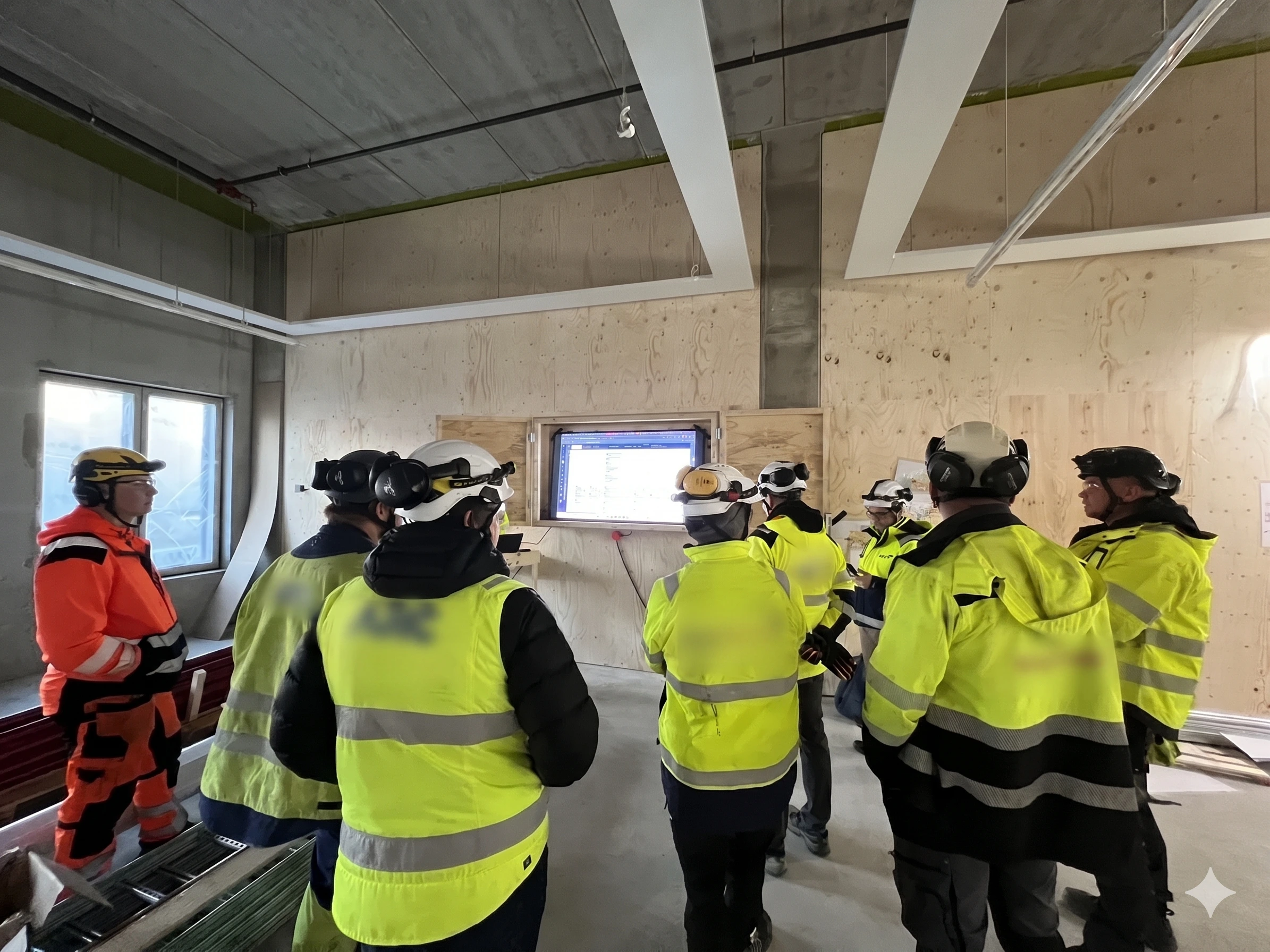
A morning huddle on a takt construction site is the short daily or weekly stand-up where the group leads from each trade meet to update progress, raise blockers, and plan the next takt. The audience is the people doing the work, not site management collecting reports. Fifteen well-run minutes resolve most of the small problems that would otherwise compound into delays.
Morning huddles sit at the centre of takt production and Lean’s continuous-improvement loop. Each group lead joins a short stand-up to report on the work just done and flag what is likely to go wrong in the next takt. The point is to get the group leads talking to each other. Most construction problems get solved fastest when the people doing the work have a forum to coordinate, rather than passing every detail up to the foreman and back down.
Information flows from one team to the next in the room, in real time. Small but urgent issues that would normally generate a chain of phone calls get resolved on the spot.
Nine practices of a well-run takt huddle
1. Hold the huddle in the same place every time
Pick one room and stick to it for the whole project, if the site allows. On most projects this ends up being the break room. A fixed location removes friction for participants, keeps the screen and laptop in place, and turns attendance into a habit faster than any policy does.
2. Run them in the morning, at the same time every week
Schedule huddles at the same time every week, and run them in the morning. A construction case study comparing supervisors who held daily morning huddles with those who didn’t found the morning-huddle group spent 30–40% more of the day on present-moment work instead of firefighting. Worker productivity rose right after the meeting and held through the shift. The exact time should be agreed with the participants.
3. Place the huddle where the work happens
Run the meeting in front of a takt control board: a board or screen showing schedule status, work in progress, and current deviations, placed close to where the work actually happens. The principle comes from manufacturing’s “shopfloor board”. Visual management reaches the people doing the work when it sits within sight of them, less so when it lives in a remote office. In practice you need a large display, a connected computer, and the site’s own internet so the schedule updates live. A break-room screen is a fine compromise; just treat it as the secondary surface and put the primary one as close to the work as the site allows.
4. Match the number of huddles to the takt length
One-week takt: one huddle a week, typically Monday morning. Half-week takt: two, for example Monday morning and Wednesday just after lunch. The shorter the takt, the more follow-up the schedule needs.
5. Keep the same people in the room every time
The standard attendees are the contractors’ group leads. The participation requirement can go into the subcontract, but enforcement matters more than paper. Site managers should actively require it. Keep the same faces across the project. They build a shared model of how the site runs and start solving problems without prompting.
6. Make the meeting useful, or attendance will drift
Attendance follows usefulness. The fastest way to motivate participation is to make sure issues raised in the room are acknowledged and worked through. Once teams notice that their own day gets easier when they bring something up, they show up willingly.
Same point, from a plumbing renovation project:
“Takt time highlighted the need for good preparation. Planning, resources, and prior work had to be ready on time. A good way to keep everyone on the project up to date was to hold morning huddles.”
— Jarmo Mattsson, Site Supervisor, Respect (plumbing renovation)
7. Hold the huddle even when nothing is wrong
When the site is running smoothly it’s tempting to skip a huddle. Don’t. A skipped routine is hard to restart, and the next problem will arrive in the middle of a project that has lost its meeting cadence.
Anticipate, don't react.
8. Have teams update their own tasks before the huddle
Huddles are most useful when teams arrive prepared. Each group lead should walk in having already updated their own task list — started, completed, interrupted — so the meeting can focus on the next takt and the current deviations instead of collecting status reports.
Done in real time, this gives the room a live snapshot of the site, rather than yesterday’s printout to argue over.
9. Use digital worklists to keep the schedule current
Digital worklists let the schedule update as people work. A printed schedule needs a fresh printout every time something moves, so it is always slightly wrong by the time anyone reads it. Digital tools also collect data on what actually happened, which makes the project analysable afterwards and the next one runs better. Mestamaster’s huddle view is built for this workflow: step through the schedule one takt at a time, run each team’s status, update the plan in the room.
A standard agenda for every huddle
A well-run huddle walks the same checklist every time:
- People — number of workers present, per contractor.
- Equipment — tools and machines available against what this takt needs.
- Schedule progress — actual completion rate against the planned takt schedule.
- Quality — errors, defects, and rework from the previous takt.
- Safety — incidents, near-misses, and work-safety issues to raise.
- Blockers — anything currently preventing a team from executing its work.
- Site condition — order, cleanliness, and logistics readiness for the next takt.
Meeting structure matters more than meeting length. Fifteen minutes with this checklist will outperform an hour without it. And when the takt is short — a one-day takt, for example — split the huddles by trade, floor, or zone rather than simply scheduling more of them.
How Mestamaster supports the huddle
Mestamaster is built around this workflow. Two surfaces matter:
Before the huddle, group leads update their own tasks on the mobile app. Each lead opens the worker task list on their phone and marks tasks as started, completed, or interrupted, attaching a photo or comment when it helps. Interruptions get a category in the moment — materials, equipment, space conflict, planning, prior work — so every blocker carries a real reason rather than a guess after the fact.
In the huddle, the Per-Takt web view is what’s on the screen. It steps through the schedule one takt at a time, shows every team’s tasks for that period, highlights deviations from plan, and lets the supervisor adjust the schedule live. Mobile updates sync instantly, so the screen reflects what the teams marked minutes before the meeting started.
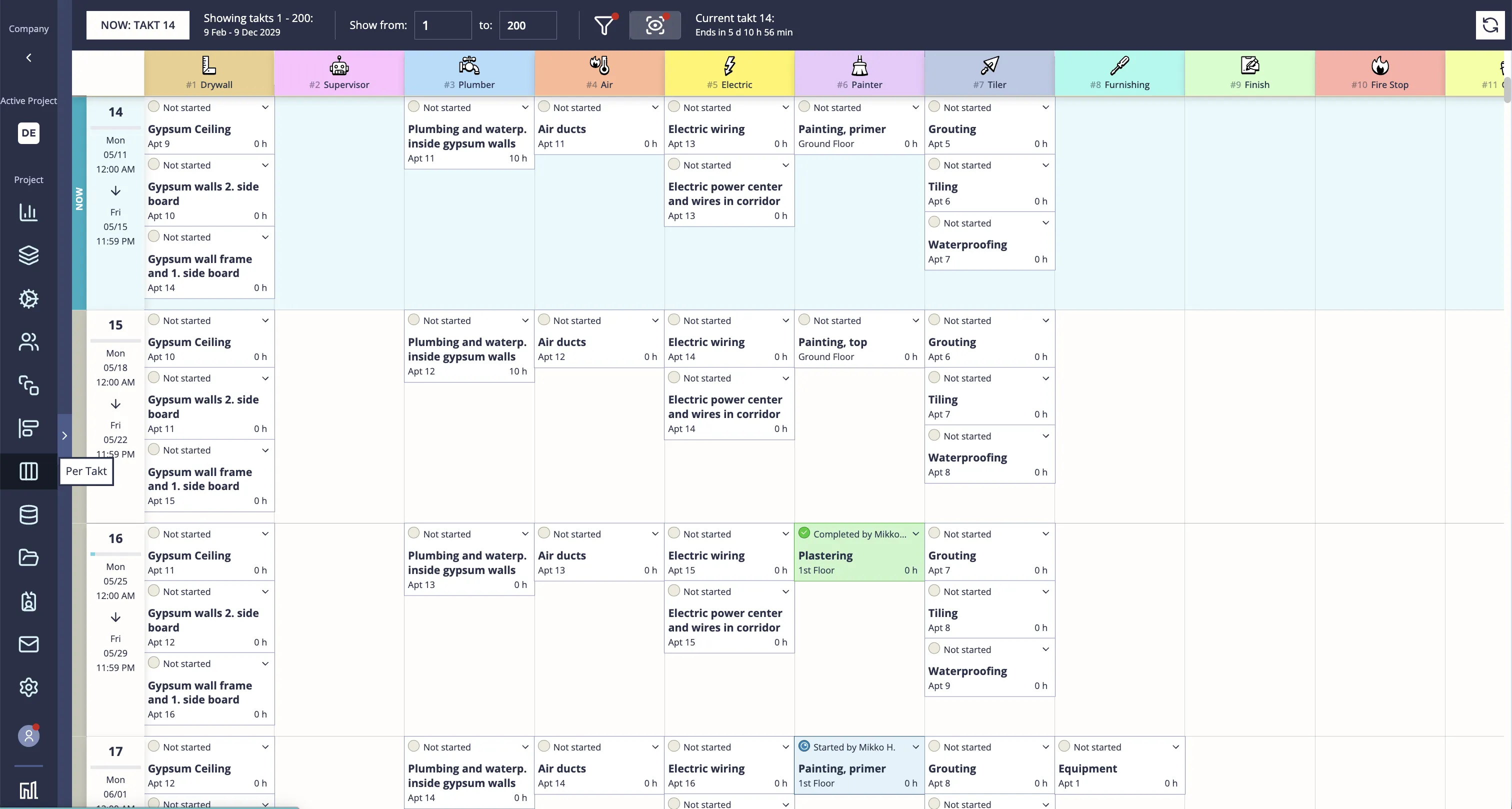
The tooling is incidental. What matters is that the whole agenda above runs as a single screen and a fifteen-minute meeting, replacing the binder, the printout, and the string of phone calls.
Make the huddle the operating rhythm of the project
Run consistently, huddles become the operating rhythm of the project. The supervisors we work with report sharper schedule predictability when huddles and takt control run together:
“Using one-week takt, we cut 10–15% off interior works — about one month off the schedule. I’ll definitely use takt in future projects.”
— Tauno Hiltunen, Project Supervisor, Lujatalo (heavy renovation)
Want to see this run on a real project? Book a free schedule draft — we’ll build one for your site, no commitment. Or read more about takt time in construction.
References
- Wandahl, S., Pérez, C. T., Salling, S., Hansen, C. H. H., Nielsen, M. K., & Nissen, T. (2023). Daily Huddles’ Effect on Crew Productivity. Proceedings of the 31st Annual Conference of the International Group for Lean Construction (IGLC31), Lille, France, pp. 1255–1266.
- Binninger, M., et al. (2017). Technical Takt Planning and Takt Control in Construction. 25th Annual Conference of the International Group for Lean Construction.
- Vihavainen, O. (2023). Best Practices of Daily Management in Takt Production. Aalto University Master’s thesis.
- Särkilahti, J. (2024). Päivittäispalaverien soveltuvuus ja vaikutukset rakennesuunnitteluprosessien hallintaan. Aalto University Master’s thesis.
- Sahlberg, J. (2020). Tahtituotannon prosessimalli korjausrakentamiseen. Aalto University Master’s thesis.
- Kujanpää, V. (2024). Logistics in Lean Construction: Exploration of Processes, Challenges and Best Practices. Aalto University Master’s thesis.
For a broader catalogue of academic work on takt production in Finland, see our research page.